
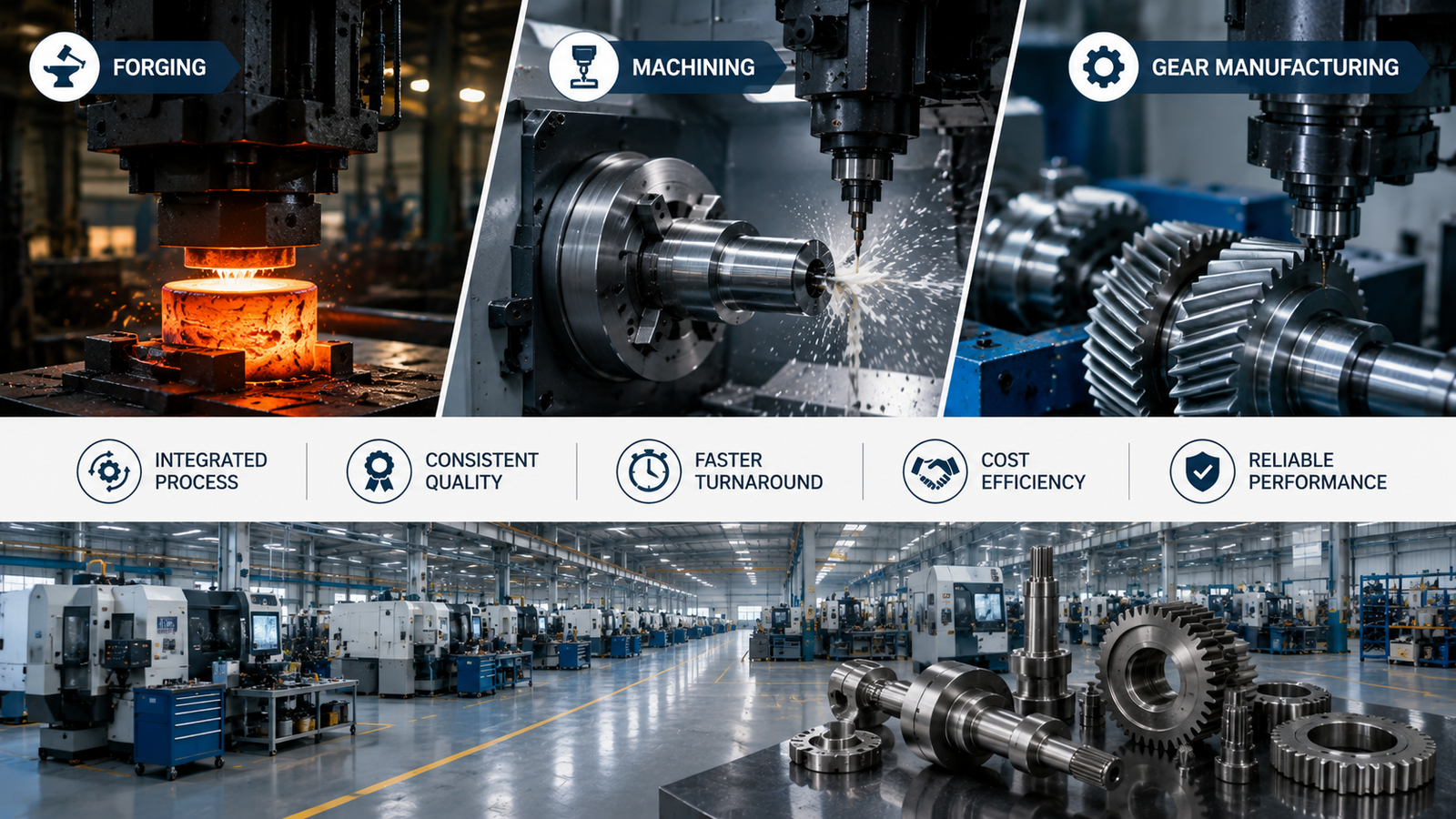
Integrated Manufacturing: The Advantage of Forging, Machining and Gear Manufacturing Under One Roof
Modern industrial supply chains are becoming increasingly demanding. Automotive manufacturers, agricultural equipment producers, construction machinery companies, hydraulic equipment manufacturers, and general engineering businesses require components with higher precision, shorter development cycles, consistent quality, and dependable delivery.
Traditionally, manufacturing a complex component could involve several independent suppliers. One company would produce the forged blank, another would perform heat treatment, a machining supplier would finish critical dimensions, and a specialist gear manufacturer might complete gear cutting and finishing operations.
While this fragmented approach can work, it introduces additional transportation, communication gaps, longer lead times, and greater difficulty in maintaining consistent quality throughout the production cycle.
Integrated manufacturing provides a different approach.
By combining forging, precision machining, gear manufacturing, quality inspection, and supporting processes within a coordinated manufacturing environment, manufacturers can achieve better process control, improved traceability, shorter production cycles, and more consistent component quality.
In this article, we explore how integrated manufacturing works and why combining forging, machining, and gear manufacturing capabilities can create significant advantages for modern industrial supply chains.
The Growing Complexity of Modern Component Manufacturing
Industrial components are becoming increasingly complex.
Manufacturers today are expected to meet demanding requirements related to:
- Tight Dimensional Tolerances
- Complex Component Geometries
- Higher Strength Requirements
- Improved Fatigue Resistance
- Superior Surface Finish
- Reliable Product Traceability
- Shorter Development Cycles
- Consistent High-Volume Production
Meeting these requirements often involves several manufacturing processes.
A component may begin as raw steel, undergo forging to achieve the required basic geometry and mechanical properties, move through heat treatment, continue into precision machining, and finally undergo grinding, gear cutting, finishing, and quality inspection.
When these processes are managed independently by multiple suppliers, coordination becomes more difficult.
Integrated manufacturing helps bring these operations into a connected production system.
What Is Integrated Manufacturing?
Integrated manufacturing refers to a production model where multiple manufacturing processes are coordinated within one organization or manufacturing ecosystem.
For precision industrial components, these capabilities may include:
- Raw Material Preparation
- Forging
- Heat Treatment
- Shot Blasting
- CNC Turning
- CNC Milling
- Drilling and Tapping
- Broaching
- Grinding
- Gear Hobbing
- Gear Shaping
- Gear Grinding
- Surface Finishing
- Quality Inspection
- Packaging and Dispatch
Instead of treating each process as an isolated activity, integrated manufacturing manages the entire component journey as one connected production flow.
This approach can provide greater visibility and control from raw material to finished component.
Forging: Building the Foundation of Component Strength
For many safety-critical and high-load industrial components, forging forms the foundation of the manufacturing process.
During forging, controlled force is applied to heated or cold material to create the required component shape while influencing the internal grain structure of the metal.
Compared with some alternative manufacturing processes, properly engineered forged components can provide:
- Improved Grain Flow
- Higher Mechanical Strength
- Better Fatigue Resistance
- Greater Impact Toughness
- Improved Structural Reliability
- Longer Component Service Life
These characteristics make forging suitable for components used in demanding applications such as automotive drivetrains, tractors, hydraulic systems, construction machinery, and heavy industrial equipment.
However, forging alone rarely produces a completely finished precision component.
Most forged parts require additional manufacturing operations before they are ready for final application.
This is where integrated machining becomes important.
Precision Machining: Turning Forged Components Into Finished Parts
Forging provides strength and near-net component geometry, while precision machining creates the dimensions, tolerances, profiles, and surface finishes required for final assembly.
Modern machining operations may include:
- CNC Turning
- CNC Milling
- Drilling
- Tapping
- Boring
- Broaching
- Grinding
- Precision Finishing
When forging and machining are managed within an integrated production environment, manufacturing engineers can optimize the relationship between the forged blank and the final machined component.
This can help reduce unnecessary material removal, simplify machining operations, improve dimensional consistency, and reduce production time.
For example, a forged blank can be designed closer to the final component geometry. This reduces machining allowance and can improve material utilization.
The result is a more efficient manufacturing process from the initial forging stage to final dimensional inspection.
The Importance of Gear Manufacturing Integration
Gears are among the most technically demanding mechanical components used in industrial systems.
They must transfer motion and torque while maintaining dimensional accuracy, durability, efficiency, and reliable operating performance.
Gear manufacturing can involve several specialized processes, including:
- Gear Blank Preparation
- CNC Turning
- Gear Hobbing
- Gear Shaping
- Gear Shaving
- Heat Treatment
- Gear Grinding
- Tooth Profile Inspection
- Dimensional Verification
When gear blank forging, machining, gear cutting, finishing, and inspection are coordinated within an integrated manufacturing system, manufacturers gain better control over the complete production chain.
This is particularly important for applications such as:
- Automotive Transmission Systems
- Agricultural Machinery
- Construction Equipment
- Industrial Gearboxes
- Hydraulic Equipment
- General Engineering Systems
Every stage of gear production affects final performance.
Material quality, forging accuracy, heat treatment, machining tolerances, tooth geometry, surface finish, and final inspection all contribute to the reliability of the finished gear.
Reduced Supplier Coordination and Production Complexity
One of the major challenges of fragmented manufacturing is supplier coordination.
Consider a component requiring:
- Forging
- Heat Treatment
- CNC Machining
- Gear Cutting
- Grinding
- Final Inspection
If each process is performed by a different supplier, the customer or primary manufacturer must manage multiple production schedules, logistics movements, quality systems, and communication channels.
This creates opportunities for delays and misunderstandings.
An integrated manufacturing approach can reduce these coordination requirements by creating a more connected production flow.
Potential benefits include:
- Fewer Supplier Interfaces
- Reduced Material Movement
- Better Production Visibility
- Simplified Communication
- Improved Scheduling
- Faster Problem Resolution
- More Consistent Documentation
For OEMs and industrial customers, this can simplify supply chain management significantly.
Shorter Development and Production Lead Times
Product development speed has become increasingly important across modern manufacturing industries.
Customers often require:
- Faster Prototype Development
- Quick Engineering Feedback
- Shorter Tooling Cycles
- Faster Sample Production
- Reliable Production Ramp-Up
When forging, machining, gear manufacturing, and quality teams work within a coordinated system, engineering decisions can move faster between departments.
For example, if a machining challenge is identified during component development, the forging design may be adjusted to improve machining efficiency.
Similarly, inspection feedback can be communicated directly to production teams without passing through multiple external suppliers.
This connected workflow can help reduce development time and improve manufacturing responsiveness.
Better Quality Control Across the Manufacturing Cycle
Quality problems do not always originate in the final production process.
A dimensional issue discovered during final inspection may have been influenced by:
- Raw Material Variation
- Incorrect Heating Parameters
- Forging Process Variation
- Heat Treatment Distortion
- Machining Setup
- Tool Wear
- Gear Cutting Parameters
In a fragmented supply chain, identifying the source of a problem can take significant time.
Integrated manufacturing provides better visibility across the complete production cycle.
Quality control can be applied at multiple stages:
Incoming Material Inspection
Raw materials are verified against defined technical and material requirements before production.
Forging Process Control
Critical process parameters and forged component dimensions are monitored during production.
In-Process Machining Inspection
Important dimensions and tolerances are checked throughout machining operations.
Gear Inspection
Gear tooth profile, pitch, runout, and dimensional characteristics can be verified using suitable inspection equipment.
Final Inspection
Completed components undergo defined dimensional, visual, and applicable functional checks before dispatch.
This multi-stage approach helps detect problems earlier and supports more consistent final product quality.
Improved Traceability and Documentation
Traceability has become increasingly important across automotive and industrial manufacturing.
Customers may require information related to:
- Raw Material Batch
- Production Date
- Manufacturing Process
- Heat Treatment Batch
- Inspection Records
- Quality Approval
- Final Dispatch
When manufacturing processes are connected, maintaining component traceability becomes more manageable.
Production records can follow the component throughout its manufacturing journey, providing greater visibility from incoming material to finished product.
This is especially valuable for critical applications where quality documentation and process history are important.
Better Design for Manufacturability
Integrated manufacturing is not only about producing components. It can also improve how components are designed for production.
Engineering teams with experience across forging, machining, and gear manufacturing can evaluate a component from multiple manufacturing perspectives.
This may help identify opportunities to:
- Improve Forging Geometry
- Reduce Machining Allowance
- Simplify Tooling
- Improve Material Utilization
- Reduce Production Operations
- Improve Inspection Accessibility
- Enhance Process Stability
This approach is commonly known as Design for Manufacturability.
Early manufacturing input can help customers avoid unnecessary production complexity and develop components that are easier and more efficient to manufacture consistently.
Material Selection for Integrated Component Manufacturing
Material selection plays a critical role in component performance.
Different industrial applications require different combinations of:
- Strength
- Hardness
- Toughness
- Fatigue Resistance
- Wear Resistance
- Corrosion Resistance
- Machinability
Depending on application requirements, industrial components may use:
- Carbon Steel
- Alloy Steel
- Stainless Steel
- Carburizing Steel Grades
- Special Engineering Materials
- Customer-Specified Material Grades
An integrated manufacturing environment allows material considerations to be evaluated across forging behavior, heat treatment response, machinability, and final component performance.
This broader understanding helps support more reliable manufacturing decisions.
Applications Across Multiple Industries
Integrated manufacturing capabilities can support a wide range of industries.
Automotive Industry
Automotive systems require components capable of operating under demanding loads, high speeds, repeated cycles, and strict dimensional requirements.
Applications may include gears, shafts, transmission components, forged parts, and precision-machined components.
Farm Equipment
Agricultural machinery operates in demanding environments involving dust, vibration, shock loads, and long operating cycles.
Reliable forged and machined components help support tractors, harvesters, tillage equipment, and other agricultural machinery.
Construction Equipment
Excavators, loaders, cranes, and other construction machinery require strong components capable of handling heavy loads and challenging working conditions.
Hydraulic Equipment
Hydraulic systems depend on accurate dimensions, reliable sealing surfaces, and durable components capable of operating under pressure.
Oil & Gas
Industrial components used in Oil & Gas applications may require high strength, material integrity, dimensional accuracy, and reliable performance in demanding environments.
General Engineering
Integrated manufacturing can support custom components for machinery, industrial equipment, power transmission systems, and specialized engineering applications.
Industry 4.0 and Connected Manufacturing
Modern manufacturing facilities are becoming increasingly connected.
Industry 4.0 technologies are helping manufacturers improve production visibility and process control through:
- Real-Time Machine Monitoring
- Industrial IoT Systems
- Production Data Collection
- Predictive Maintenance
- Automated Inspection
- Digital Quality Records
- Production Planning Systems
When multiple manufacturing capabilities operate within a connected production environment, digital systems can provide greater visibility across the entire manufacturing chain.
This helps manufacturers identify production bottlenecks, monitor equipment performance, improve maintenance planning, and support continuous improvement.
Sustainability Benefits of Integrated Manufacturing
Sustainability is becoming increasingly important across global manufacturing supply chains.
Integrated production can support sustainability initiatives through:
- Reduced Inter-Facility Transportation
- Improved Material Utilization
- Lower Scrap Generation
- Energy-Efficient Machinery
- Process Optimization
- Waste Reduction
- Material Recycling
- Renewable Energy Adoption
For example, designing forged blanks closer to final component geometry can reduce machining waste.
Similarly, reducing unnecessary transportation between multiple suppliers can lower logistics requirements.
Sustainability improvements often come from many small process optimizations working together across the manufacturing cycle.
The Future of Integrated Manufacturing
Industrial manufacturing is expected to become increasingly connected, automated, and data-driven.
Future developments may include:
- AI-Based Quality Inspection
- Automated Production Cells
- Smart Forging Systems
- Adaptive CNC Machining
- Digital Production Traceability
- Predictive Quality Control
- Robotic Material Handling
- Energy-Optimized Manufacturing
Manufacturers capable of combining strong engineering knowledge with modern production technology will be better positioned to support increasingly complex customer requirements.
Integrated manufacturing will continue playing an important role as OEMs seek suppliers capable of providing greater technical capability, production visibility, and supply chain reliability.
Why OEMs Prefer Integrated Manufacturing Partners
OEMs and industrial customers increasingly evaluate suppliers based on more than individual machine capabilities.
They look for manufacturing partners capable of providing:
- Engineering Support
- Multiple Manufacturing Processes
- Consistent Quality
- Reliable Capacity
- Product Traceability
- Technical Communication
- Scalable Production
- Dependable Delivery
A supplier with integrated forging, machining, gear manufacturing, and inspection capabilities can provide a more complete manufacturing solution.
This approach helps customers reduce supply chain complexity while maintaining greater visibility over component production.
Conclusion
Modern industrial manufacturing requires more than individual production processes operating independently.
The combination of forging, precision machining, gear manufacturing, quality inspection, and supporting technologies creates a connected manufacturing ecosystem capable of delivering stronger process control, improved quality consistency, better traceability, and more efficient production.
From forged blanks and precision-machined components to finished gears and complex industrial parts, integrated manufacturing helps ensure that every stage of production works toward the same engineering and quality objectives.
As automotive, agricultural, construction, hydraulic, Oil & Gas, and general engineering industries continue evolving, integrated manufacturing capabilities will become increasingly important for supporting complex component requirements and reliable global supply chains.
Explore Flexico International’s Integrated Manufacturing Capabilities
Looking for a manufacturing partner with integrated capabilities across forging, precision machining, and gear manufacturing?
Flexico International supports industrial customers with engineering-focused manufacturing solutions designed for precision, reliability, and consistent production performance.
Explore our capabilities in forging, CNC machining, gear manufacturing, quality inspection, and precision-engineered component production for automotive, farm equipment, construction equipment, hydraulic systems, Oil & Gas, and general engineering applications.
Your Blueprint, Our Precision.