
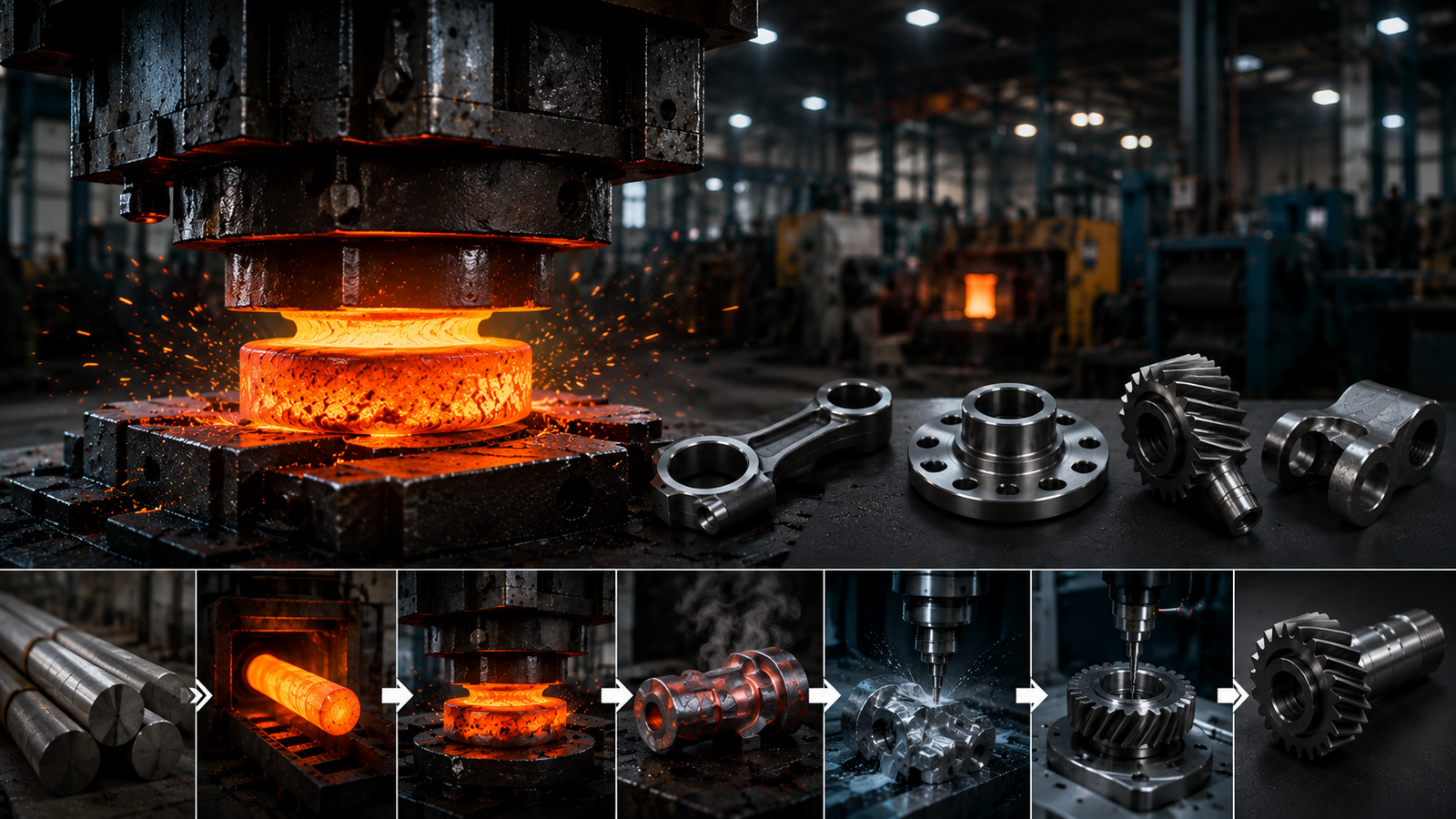
How Precision Forging Improves Strength and Durability in Critical Components
Critical industrial components operate under demanding conditions. Automotive drivetrains experience repeated torque cycles, agricultural machinery works through long operating hours and shock loads, construction equipment handles heavy forces, and hydraulic systems require components that perform reliably under pressure.
In these applications, component failure can result in equipment downtime, costly repairs, production delays, and safety concerns.
This is why the manufacturing process used to produce a component matters.
Precision forging is widely used for components requiring high strength, fatigue resistance, impact toughness, and long service life. Unlike manufacturing methods that simply remove material to create the required shape, forging forms metal under controlled force and can develop favorable grain flow within the component.
When combined with proper material selection, tooling, heat treatment, precision machining, and quality inspection, forging provides a strong foundation for manufacturing reliable components for demanding industrial applications.
In this article, we explore how precision forging improves component strength and durability, the main forging methods, and why forged components are widely used across automotive, farm equipment, construction machinery, hydraulic systems, and general engineering.
What Is Precision Forging?
Forging is a manufacturing process in which metal is shaped using controlled compressive force.
Depending on the process and component requirements, the material may be heated before forming or processed under other controlled temperature conditions.
A typical forging process may include:
- Raw Material Selection
- Billet Cutting
- Controlled Heating
- Forging and Forming
- Trimming
- Heat Treatment
- Shot Blasting or Cleaning
- Precision Machining
- Final Inspection
Precision forging focuses on controlling the material, tooling, temperature, forming process, and component geometry to achieve consistent production results.
The objective is not only to create the required shape but also to produce a component with mechanical properties suitable for its final operating conditions.
How Forging Improves Material Strength
One of the most important advantages of forging is its influence on the internal grain structure of the material.
Metal contains an internal grain structure. During controlled forging, the material flows into the shape of the component, allowing the grain flow to follow the geometry of the part.
This can contribute to:
- Improved Mechanical Strength
- Better Fatigue Resistance
- Greater Impact Toughness
- Improved Structural Integrity
- Reliable Performance Under Repeated Loading
For critical components such as shafts, gears, axle parts, couplings, and heavy-duty equipment components, this internal material structure is important.
A component may appear dimensionally correct but still perform poorly if the material structure is unsuitable for the application.
Forging helps create a strong material foundation before machining and finishing operations begin.
Why Grain Flow Matters
Grain flow is one of the key reasons forging is selected for highly loaded components.
During the forging process, material deformation can align the grain structure with the shape of the component.
This is particularly valuable in areas that experience repeated stress.
Components such as:
- Shafts
- Connecting Components
- Gear Blanks
- Axle Parts
- Flanges
- Couplings
- Transmission Components
may experience cyclic loading throughout their operating life.
Controlled grain flow can help the component resist crack initiation and propagation under repeated stress.
The effectiveness depends on correct forging design, process control, material selection, and heat treatment.
This is why precision forging requires engineering knowledge rather than simply applying force to heated material.
Closed Die Forging for Precision Components
Closed die forging is widely used for producing repeatable components with defined geometries.
In this process, heated material is placed between shaped dies. Controlled force causes the material to flow into the die cavity and create the required form.
Closed die forging can provide:
- Repeatable Component Geometry
- Good Material Utilization
- Consistent Production
- Improved Mechanical Properties
- Near-Net Shape Manufacturing
- Suitability for Medium and High Production Volumes
Typical applications may include:
- Automotive Components
- Gear Blanks
- Transmission Parts
- Agricultural Equipment Components
- Hydraulic Components
- Construction Equipment Parts
Producing a forged blank closer to the final component geometry can also reduce the amount of material that must be removed during machining.
This can improve manufacturing efficiency and material utilization.
Open Die Forging for Specialized Requirements
Open die forging shapes metal between dies that do not completely enclose the material.
The process allows greater flexibility for larger components, lower production quantities, and specialized geometries.
Open die forging may be suitable for:
- Large Shafts
- Rings
- Cylindrical Components
- Heavy-Duty Industrial Parts
- Low-Volume Specialized Components
The material is progressively shaped through controlled deformation.
Compared with closed die forging, open die forging generally provides greater flexibility but may require additional machining to achieve final dimensions.
The correct forging method depends on component size, geometry, production volume, material, and application requirements.
Forging and Fatigue Resistance
Many industrial components do not fail because of one extreme load.
Instead, they experience thousands or millions of repeated loading cycles.
This is known as cyclic loading.
Applications involving cyclic loads include:
- Automotive Drivetrains
- Agricultural Transmissions
- Construction Machinery
- Industrial Gearboxes
- Hydraulic Systems
- Rotating Equipment
Repeated stress can eventually cause fatigue cracks.
Forged components are widely used in these applications because controlled material flow and appropriate heat treatment can provide strong fatigue performance.
However, forging alone does not guarantee fatigue resistance.
Final performance also depends on:
- Material Quality
- Forging Design
- Surface Condition
- Heat Treatment
- Machining Quality
- Stress Concentration
- Operating Environment
A properly controlled manufacturing process must consider all these factors together.
Impact Toughness for Heavy-Duty Applications
Farm and construction equipment often experience sudden or changing loads.
Examples include:
- Tractor Implements Entering Hard Soil
- Excavator Buckets Striking Dense Material
- Loader Drivetrains Under Sudden Torque Changes
- Hydraulic Equipment Experiencing Pressure Variations
- Industrial Machinery During Start-Stop Operations
Components in these applications require more than static strength.
They also need toughness—the ability to absorb energy and resist fracture under impact or sudden loading.
Forging, combined with appropriate material selection and heat treatment, can provide a useful balance between strength and toughness.
This makes forged components suitable for many demanding heavy-duty applications.
The Role of Material Selection
The performance of a forged component begins with selecting the appropriate material.
Depending on the application, manufacturers may work with:
- Carbon Steel
- Alloy Steel
- Stainless Steel
- Carburizing Steel Grades
- Special Engineering Materials
- Customer-Specified Grades
Material selection depends on required properties such as:
- Tensile Strength
- Yield Strength
- Hardness
- Toughness
- Fatigue Resistance
- Wear Resistance
- Corrosion Resistance
- Machinability
- Heat Treatment Response
There is no single material suitable for every forged component.
A transmission component and a hydraulic component may have very different operating conditions and performance requirements.
Material selection must therefore be based on actual application needs.
Heat Treatment and Forged Component Performance
After forging, many components undergo heat treatment to achieve required mechanical properties.
Depending on component requirements, heat treatment processes may include:
- Normalizing
- Annealing
- Hardening
- Tempering
- Carburizing
- Induction Hardening
Heat treatment can influence:
- Hardness
- Core Toughness
- Wear Resistance
- Fatigue Strength
- Dimensional Stability
- Service Life
For wear-critical components such as gears, a hard surface may be required to resist wear while maintaining sufficient core toughness.
Process control is essential.
Incorrect heat treatment can create dimensional distortion, inconsistent hardness, or unsuitable mechanical properties.
For this reason, heat treatment and quality verification are important parts of the complete forging process.
Precision Machining After Forging
Forging creates the basic component form and material structure, but critical components often require additional machining.
Machining operations may include:
- CNC Turning
- CNC Milling
- Drilling
- Tapping
- Broaching
- Grinding
- Gear Cutting
- Precision Finishing
Combining forging and precision machining allows manufacturers to achieve both structural strength and dimensional accuracy.
The forged blank provides the mechanical foundation, while machining creates:
- Accurate Diameters
- Bearing Seats
- Threads
- Splines
- Keyways
- Holes
- Gear Teeth
- Precision Mating Surfaces
An integrated approach can also help optimize the forged blank for efficient machining.
Forged Components in Automotive Applications
Automotive systems contain many components that operate under repeated loads and demanding performance conditions.
Forged components may be used in:
- Transmission Systems
- Drivetrain Components
- Shafts
- Gear Blanks
- Differential Components
- Couplings
- Suspension and Steering Applications
Modern vehicles require components that support efficiency, reliability, reduced weight, and long operating life.
As electric and hybrid vehicles continue developing, drivetrain configurations are changing, but strong and precisely manufactured mechanical components remain important.
Forging for Farm Equipment
Agricultural machinery operates under demanding conditions involving:
- Dust
- Mud
- Vibration
- Shock Loading
- Long Operating Hours
- Seasonal Production Pressure
Tractors, harvesters, tillage equipment, and other machines depend on reliable transmission and mechanical components.
Forged parts can support applications including:
- Shafts
- Gear Blanks
- Axle Components
- Linkage Parts
- Couplings
- Hydraulic System Components
Durability is especially important because equipment failure during planting or harvesting periods can cause significant operational disruption.
Forging for Construction Equipment
Construction machinery handles high loads in difficult working environments.
Excavators, loaders, cranes, bulldozers, and other equipment require components capable of handling:
- Heavy Torque
- Repeated Impact
- Continuous Vibration
- Variable Loads
- Long Operating Cycles
Forged components are used where strength, toughness, and fatigue resistance are critical.
Potential applications include:
- Drive Components
- Shafts
- Gears and Gear Blanks
- Couplings
- Hydraulic Components
- Heavy-Duty Machine Parts
Reliable component manufacturing contributes directly to equipment availability and reduced downtime.
Quality Control in Precision Forging
Consistent forging quality requires inspection throughout the manufacturing process.
Quality control may include:
Raw Material Verification
Material grades and applicable documentation are checked before production.
Process Monitoring
Critical forging parameters are controlled according to defined process requirements.
Dimensional Inspection
Forged dimensions are checked before components move to later production stages.
Hardness Testing
Material hardness may be verified after applicable heat treatment processes.
Metallurgical Inspection
Material structure may be analyzed where required by product specifications.
Final Inspection
Machined and finished components undergo dimensional and visual verification before approval.
Quality control is not only about rejecting defective parts.
Its more important purpose is to control the manufacturing process and prevent variation.
Precision Forging and Material Efficiency
Manufacturing efficiency is becoming increasingly important across industrial supply chains.
Near-net shape forging can help reduce unnecessary material removal during machining.
Potential advantages include:
- Better Material Utilization
- Reduced Machining Time
- Lower Metal Scrap Generation
- Improved Production Efficiency
- Reduced Processing Requirements
Forging operations can also support broader sustainability initiatives through energy efficiency improvements, material recycling, waste reduction, and optimized production planning.
Sustainability in manufacturing depends on improving the complete production system rather than relying on a single process change.
Future Trends in Precision Forging
Forging technology continues to evolve.
Modern manufacturers are increasingly adopting:
- Automated Material Handling
- Controlled Induction Heating
- Digital Process Monitoring
- Advanced Die Design
- Simulation-Based Process Development
- Robotic Production Systems
- Predictive Maintenance
- Automated Quality Inspection
- Production Data Analytics
Forging simulation can help engineers understand material flow before physical tooling and production begin.
Digital monitoring can improve visibility into production conditions and support more consistent process control.
As industrial components become more complex and performance requirements increase, precision forging will continue combining traditional metal-forming principles with modern manufacturing technology.
Why Manufacturers Continue to Choose Forged Components
Despite advances in alternative manufacturing technologies, forging remains important for critical industrial components.
Manufacturers select forged components because they can provide:
- High Strength
- Reliable Fatigue Performance
- Impact Resistance
- Material Integrity
- Production Repeatability
- Long Service Life
- Suitability for Demanding Applications
However, the performance of a forged component depends on the complete manufacturing system.
Material selection, die design, forging parameters, heat treatment, machining, inspection, and documentation must work together.
This is why technically demanding applications require manufacturing partners with both production capability and process control.
Conclusion
Precision forging plays an important role in manufacturing components that must perform reliably under demanding loads and operating conditions.
By shaping material under controlled force, forging can create favorable grain flow, improve mechanical strength, support fatigue resistance, and provide the toughness required for critical industrial applications.
When combined with appropriate material selection, heat treatment, precision machining, and systematic quality control, forging provides a strong manufacturing foundation for automotive components, agricultural machinery parts, construction equipment components, hydraulic systems, and general engineering applications.
As industrial equipment continues to demand higher performance, improved durability, and greater manufacturing consistency, precision forging will remain an essential technology for producing critical components.
Explore Flexico International’s Forging Capabilities
Looking for a manufacturing partner for precision-forged and finished industrial components?
Flexico International supports customers with capabilities across forging, heat treatment coordination, precision machining, gear manufacturing, and quality-controlled component production.
Our manufacturing solutions support forged components, gear blanks, shafts, transmission parts, hydraulic components, and custom-engineered products for automotive, farm equipment, construction equipment, hydraulic systems, and general engineering applications.
Your Blueprint, Our Precision.