
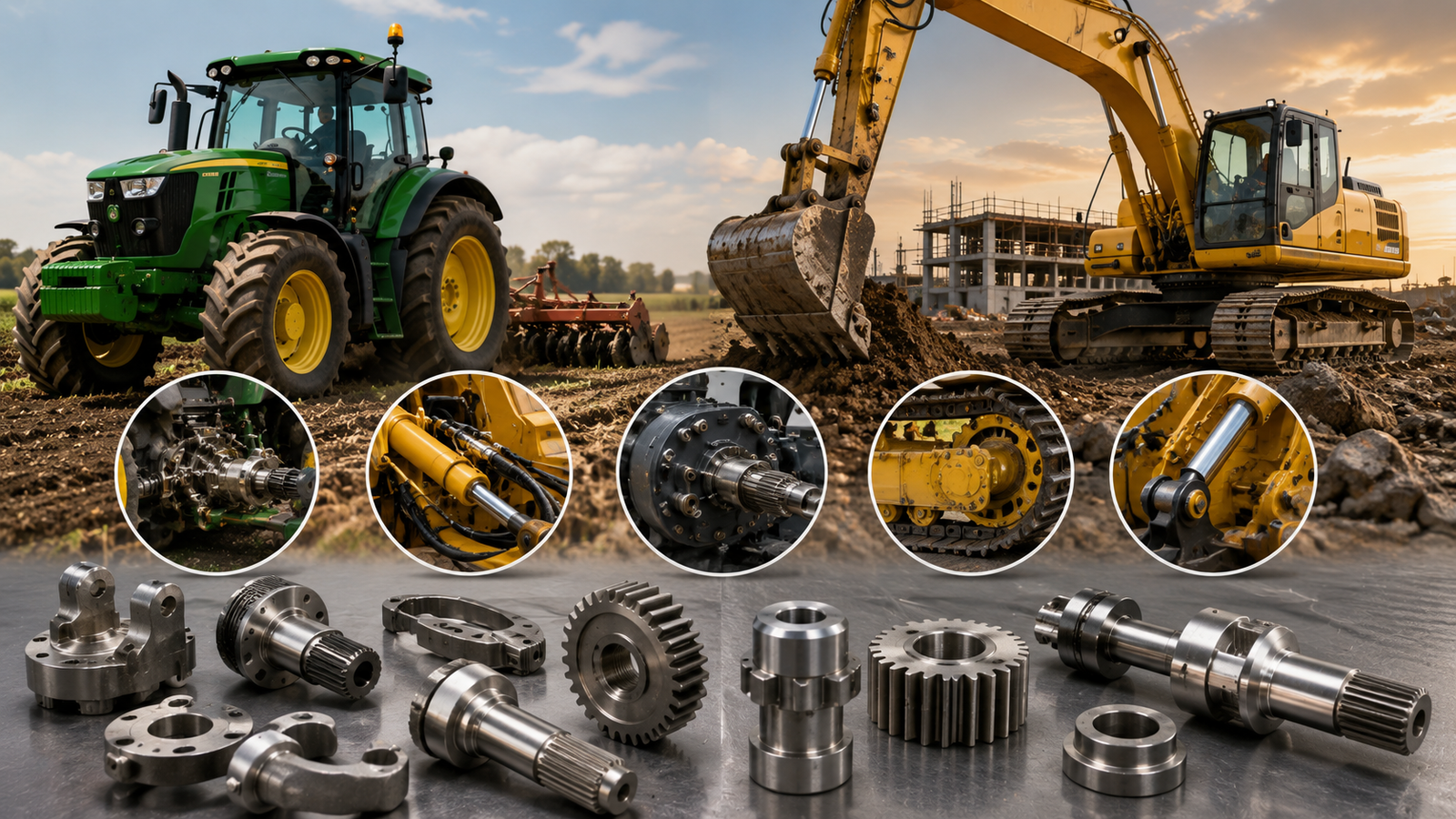
How Precision Components Improve Performance in Farm and Construction Equipment
Farm and construction equipment operate in some of the most demanding working environments in the world. Tractors, harvesters, excavators, loaders, bulldozers, cranes, and other heavy-duty machines must perform reliably under high loads, continuous vibration, dust, mud, temperature variations, and long operating cycles.
Behind the performance of these machines are thousands of mechanical components working together.
Gears transfer power through transmission systems. Shafts carry torque between rotating assemblies. Forged components withstand repeated impact and fatigue loads. Precision-machined parts maintain accurate alignment, while hydraulic components control the movement of heavy equipment under significant pressure.
The quality and accuracy of these components directly influence equipment performance, efficiency, durability, maintenance requirements, and service life.
As agricultural and construction machinery becomes more powerful, automated, connected, and energy-efficient, manufacturers increasingly require components with tighter tolerances, improved materials, better surface finishes, and greater reliability.
In this article, we explore how precision-engineered components improve the performance of farm and construction equipment and why advanced forging, machining, gear manufacturing, and quality control processes are essential for modern heavy machinery.
The Demanding Operating Environment of Heavy Equipment
Farm and construction equipment rarely operates under ideal conditions.
Agricultural machinery may work continuously during critical planting and harvesting periods. Construction equipment may operate for extended shifts on rough terrain while handling heavy loads.
These machines are regularly exposed to:
- Heavy Shock Loads
- Continuous Vibration
- High Torque Requirements
- Dust and Contamination
- Mud and Moisture
- Extreme Temperature Variations
- Repeated Start-Stop Cycles
- Long Operating Hours
- Uneven Terrain
- High Hydraulic Pressure
A small component failure can stop an entire machine.
For a farmer during harvest season or a contractor working on a time-sensitive infrastructure project, equipment downtime can result in significant operational and financial losses.
This is why component reliability is a critical engineering requirement rather than simply a manufacturing preference.
Why Precision Matters in Farm and Construction Machinery
Heavy-duty machinery contains many interacting mechanical systems.
A transmission gear must engage accurately with its mating gear. A shaft must maintain correct alignment while transferring torque. A hydraulic component must maintain dimensional accuracy to support pressure control and reliable sealing.
Small dimensional variations can affect:
- Gear Engagement
- Noise and Vibration
- Power Transmission Efficiency
- Bearing Life
- Seal Performance
- Component Wear
- Fuel Consumption
- Machine Reliability
Precision manufacturing helps ensure that components fit and operate according to their intended engineering requirements.
This becomes increasingly important as equipment manufacturers develop machines with higher power density, more compact systems, improved fuel efficiency, and greater automation.
The Role of Forged Components in Heavy-Duty Equipment
Forging is widely used for components that must withstand high mechanical loads, repeated stress, and demanding operating conditions.
During the forging process, material is formed under controlled force to create the required component geometry while developing favorable internal grain flow.
Properly engineered forged components can provide:
- High Mechanical Strength
- Improved Fatigue Resistance
- Better Impact Toughness
- Reliable Structural Integrity
- Consistent Material Properties
- Long Component Service Life
These characteristics make forging suitable for many farm and construction equipment applications.
Typical forged components may include:
- Shafts
- Axle Components
- Gear Blanks
- Flanges
- Couplings
- Levers
- Linkage Components
- Transmission Parts
- Hydraulic System Components
- Custom Heavy-Duty Components
In applications where components experience repeated impact or cyclic loading, material integrity is particularly important.
Precision Gears and Power Transmission Efficiency
Gears are fundamental to the operation of agricultural and construction machinery.
They transfer torque, control speed, change rotational direction, and distribute power across different machine systems.
Heavy equipment may use various gear types depending on the application:
- Spur Gears
- Helical Gears
- Bevel Gears
- Worm Gears
- Planetary Gear Systems
- Internal Gears
Precision gear geometry helps support smooth tooth engagement and effective load distribution.
Poor gear accuracy can contribute to:
- Excessive Noise
- Increased Vibration
- Uneven Tooth Loading
- Premature Wear
- Reduced Efficiency
- Higher Operating Temperature
- Shorter Gearbox Life
Accurate gear manufacturing processes such as hobbing, shaping, shaving, grinding, and profile inspection help manufacturers achieve the required tooth geometry and surface quality.
For equipment operating continuously under high torque, reliable gear performance is essential.
Transmission Components in Agricultural Equipment
Modern agricultural machinery relies on increasingly sophisticated transmission systems.
Tractors, harvesters, seeders, and other equipment require controlled power delivery across different speeds and load conditions.
Transmission systems may contain:
- Gears
- Shafts
- Splines
- Couplings
- Differential Components
- Planetary Gear Sets
- Bearings and Housings
Precision manufacturing helps maintain alignment and accurate interaction between these components.
In tractors, transmission components must handle varying loads as equipment moves across different terrain or operates attached implements.
Harvesting machinery may require multiple synchronized systems operating simultaneously.
Reliable power transmission helps improve machine productivity and reduce the risk of unexpected breakdowns during critical agricultural operations.
Precision Components in Construction Equipment
Construction machinery performs heavy lifting, digging, loading, grading, and material movement operations.
Machines such as excavators, loaders, bulldozers, cranes, and compactors depend on mechanical and hydraulic systems operating together.
Critical components may include:
- Transmission Gears
- Drive Shafts
- Planetary Gears
- Axle Components
- Hydraulic Components
- Pins and Bushes
- Couplings
- Structural Forgings
- Precision-Machined Parts
These components often operate under changing loads and repeated stress cycles.
A bucket excavating compacted soil creates different loading conditions than an excavator traveling across uneven terrain. Similarly, a loader transmission experiences repeated changes in speed, direction, and load.
Components must be engineered and manufactured to perform consistently across these changing operating conditions.
Hydraulic Systems and the Importance of Precision
Hydraulic systems are central to modern farm and construction equipment.
They control operations such as:
- Excavator Boom Movement
- Loader Bucket Control
- Tractor Implement Operation
- Steering Systems
- Lifting Mechanisms
- Stabilization Systems
- Braking Functions
Hydraulic systems operate using pressurized fluid.
Dimensional accuracy and surface quality are important because small manufacturing variations can affect sealing, leakage control, pressure stability, and system efficiency.
Precision machining processes help produce hydraulic components with controlled:
- Bore Dimensions
- Surface Finish
- Concentricity
- Thread Accuracy
- Sealing Surfaces
- Component Alignment
Reliable hydraulic components help equipment deliver smooth, predictable, and efficient movement.
CNC Machining for Complex Equipment Components
Many farm and construction equipment components require multiple machining operations before reaching their final geometry.
Modern CNC machining processes may include:
- CNC Turning
- CNC Milling
- Drilling
- Tapping
- Boring
- Broaching
- Grinding
- Precision Finishing
CNC machining provides repeatability and dimensional control across production batches.
For complex components, multiple features may need to maintain accurate relationships with each other.
For example, a shaft may require precise diameters, shoulders, threads, keyways, and bearing surfaces. Each feature must work correctly within the final assembly.
Controlled machining processes help achieve these requirements consistently.
The Importance of Material Selection
Different equipment components require different material properties.
A gear may require high surface hardness combined with a tough core. A shaft may require strength and fatigue resistance. A hydraulic component may require dimensional stability and suitable wear characteristics.
Material selection may consider:
- Tensile Strength
- Yield Strength
- Hardness
- Toughness
- Fatigue Resistance
- Wear Resistance
- Corrosion Resistance
- Heat Treatment Response
- Machinability
Depending on the application, components may be manufactured from:
- Carbon Steel
- Alloy Steel
- Stainless Steel
- Carburizing Steel Grades
- Special Engineering Materials
- Customer-Specified Material Grades
Selecting the appropriate material is only the first step.
Forging parameters, heat treatment, machining processes, and finishing operations must also be controlled to achieve the required component performance.
Heat Treatment and Component Performance
Heat treatment is used to modify the mechanical properties of metal components.
Depending on component requirements, processes may include:
- Hardening
- Tempering
- Normalizing
- Annealing
- Carburizing
- Induction Hardening
Heat treatment can influence:
- Surface Hardness
- Core Toughness
- Wear Resistance
- Fatigue Strength
- Dimensional Stability
- Component Service Life
For gears and other wear-critical components, the relationship between surface hardness and core toughness is particularly important.
A hard surface helps resist wear, while a tougher core helps the component withstand impact and repeated loading.
Process control during heat treatment is therefore an important part of component manufacturing.
Surface Finish and Wear Reduction
Surface finish affects how mechanical components interact during operation.
Rough or inconsistent surfaces can increase:
- Friction
- Heat Generation
- Wear
- Noise
- Energy Loss
Precision grinding and finishing processes help create controlled surfaces for applications such as:
- Bearing Seats
- Gear Teeth
- Hydraulic Sealing Areas
- Shaft Surfaces
- Mating Components
Improved surface quality can contribute to smoother operation, better lubrication performance, and longer component life.
For high-cycle machinery, small improvements in wear performance can have a meaningful effect over thousands of operating hours.
Reducing Equipment Downtime Through Component Reliability
Downtime is one of the most expensive challenges in agriculture and construction operations.
Equipment failure can interrupt:
- Harvesting
- Planting
- Excavation
- Road Construction
- Material Handling
- Infrastructure Development
- Site Preparation
The cost of downtime may include more than component replacement.
It can also involve:
- Lost Production Time
- Labor Delays
- Equipment Rental Costs
- Emergency Repairs
- Project Schedule Disruption
- Agricultural Yield Risk
Reliable components help reduce the likelihood of premature mechanical failure.
This is why equipment manufacturers carefully evaluate material quality, manufacturing processes, dimensional accuracy, heat treatment, and quality inspection when selecting component suppliers.
Quality Control for Heavy Equipment Components
Heavy-duty components require systematic quality control throughout production.
Quality inspection may begin with raw material verification and continue through every major manufacturing stage.
A typical quality process may include:
Incoming Material Inspection
Raw materials are checked against applicable specifications and technical requirements.
Forging Inspection
Forged components are evaluated for dimensional requirements, surface condition, and applicable process criteria.
In-Process Machining Inspection
Critical dimensions are monitored throughout machining operations.
Gear Inspection
Gear tooth profile, pitch, runout, and other relevant parameters are checked using suitable measuring equipment.
Surface and Hardness Testing
Surface finish and material hardness may be verified according to component requirements.
Final Inspection
Completed components undergo defined dimensional and visual checks before approval and dispatch.
A strong quality system helps detect process variation before it becomes a field performance issue.
Traceability in Component Manufacturing
Traceability is increasingly important for modern equipment manufacturers.
Depending on customer and component requirements, production records may include:
- Material Batch Information
- Manufacturing Lot
- Heat Treatment Records
- Machine Process Data
- Inspection Reports
- Quality Approval
- Dispatch Information
Traceability helps manufacturers investigate quality concerns, improve processes, and maintain reliable production records.
For critical components, this information provides valuable visibility across the manufacturing cycle.
Integrated Manufacturing and Supply Chain Efficiency
A single component may require forging, heat treatment, machining, gear cutting, grinding, and final inspection.
When these operations are distributed across multiple independent suppliers, the supply chain becomes more complex.
Integrated manufacturing can help improve coordination between:
- Forging
- Machining
- Gear Manufacturing
- Heat Treatment
- Quality Inspection
- Packaging and Dispatch
Potential advantages include:
- Reduced Material Movement
- Better Process Coordination
- Faster Engineering Communication
- Improved Traceability
- Shorter Lead Times
- Consistent Quality Control
- Simplified Supplier Management
For farm and construction equipment manufacturers, reliable supply chain performance is particularly important because production programs often involve multiple component variants and changing demand requirements.
The Growth of Smart Agricultural Machinery
Agriculture is becoming increasingly technology-driven.
Modern farm equipment may include:
- GPS Guidance
- Automated Steering
- Variable Rate Technology
- Telemetry Systems
- Sensor-Based Monitoring
- Autonomous Operation
- Precision Farming Systems
While software and electronics receive significant attention, mechanical components remain essential.
Automated equipment still depends on reliable gears, shafts, transmissions, hydraulic components, and precision-machined parts.
As agricultural machinery becomes more advanced, component reliability becomes even more important because mechanical failures can affect increasingly sophisticated and expensive equipment systems.
Technology Trends in Construction Machinery
Construction equipment is also evolving rapidly.
Manufacturers are developing:
- Electric Construction Equipment
- Hybrid Powertrains
- Automated Machine Control
- Remote Equipment Monitoring
- Predictive Maintenance Systems
- Connected Fleet Management
- Energy-Efficient Hydraulic Systems
These technologies are changing component requirements.
Electric and hybrid machines may require compact drivetrain systems, high-efficiency gears, reduced noise, and new transmission configurations.
Connected equipment also generates operational data that can help identify wear patterns and maintenance requirements.
Precision component manufacturing will continue adapting alongside these technology developments.
Sustainability in Heavy Equipment Manufacturing
Sustainability is becoming an important consideration across agriculture, construction, and industrial manufacturing.
Equipment manufacturers and component suppliers are working to improve sustainability through:
- Energy-Efficient Production
- Renewable Energy Usage
- Material Recycling
- Scrap Reduction
- Improved Material Utilization
- Longer Component Service Life
- Reduced Transportation Requirements
Durable components can also contribute indirectly to sustainability.
A component that performs reliably for a longer period reduces replacement frequency, maintenance requirements, and material consumption over the equipment lifecycle.
Manufacturing efficiency and component durability therefore both play a role in responsible industrial production.
Future Trends in Farm and Construction Equipment Components
The next generation of heavy equipment will require components capable of supporting greater performance, efficiency, and digital integration.
Future trends may include:
- Lightweight High-Strength Components
- High-Efficiency Gear Systems
- Electrified Drivetrains
- Advanced Surface Engineering
- Smart Condition Monitoring
- Improved Hydraulic Efficiency
- Automated Quality Inspection
- Digital Production Traceability
- Predictive Component Maintenance
Manufacturers capable of combining material expertise, forging, precision machining, gear manufacturing, and advanced quality control will be well positioned to support these changing requirements.
Why Equipment Manufacturers Need Reliable Component Partners
Farm and construction equipment manufacturers require more than basic component production.
They need manufacturing partners capable of understanding:
- Technical Drawings
- Material Requirements
- Dimensional Tolerances
- Application Loads
- Production Volumes
- Quality Documentation
- Delivery Requirements
- Continuous Improvement
Reliable component manufacturing requires coordination between engineering, production, quality, and supply chain teams.
For OEMs and equipment manufacturers, working with technically capable suppliers can help improve component quality, simplify communication, and support dependable production programs.
Conclusion
Farm and construction equipment operate under conditions where component reliability directly affects machine productivity, operating costs, and equipment availability.
Precision gears improve power transmission. Forged components provide strength and fatigue resistance. CNC-machined parts maintain dimensional accuracy. Hydraulic components support controlled movement under pressure, while systematic quality inspection helps ensure manufacturing consistency.
As agricultural and construction machinery becomes more powerful, automated, connected, and energy-efficient, the demand for high-quality precision components will continue to increase.
The future performance of heavy equipment will depend not only on advanced electronics and software but also on the strength, accuracy, durability, and reliability of the mechanical components operating inside every machine.
Explore Flexico International’s Precision Component Manufacturing Capabilities
Looking for a manufacturing partner for precision components used in farm equipment, construction machinery, hydraulic systems, and heavy-duty engineering applications?
Flexico International supports industrial customers with integrated capabilities across forging, precision machining, gear manufacturing, inspection, and quality-controlled component production.
Our manufacturing capabilities support the production of gears, shafts, forged components, precision-machined parts, hydraulic equipment components, and custom-engineered industrial products for demanding applications.
Your Blueprint, Our Precision.