
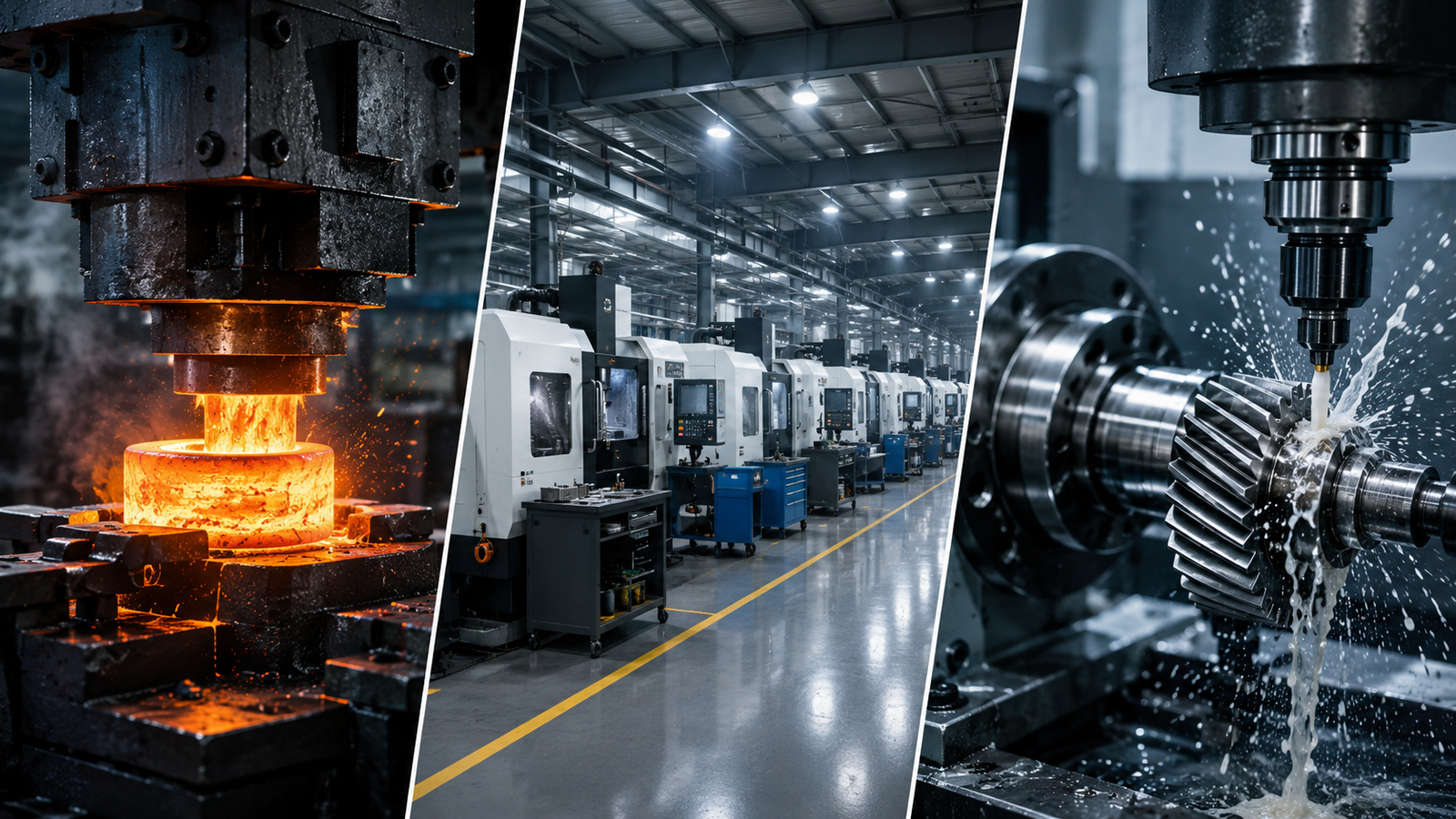
Integrated Manufacturing: How Forging, Machining, and Gear Manufacturing Work Together
Modern manufacturing demands more than producing individual components. Industries such as automotive, farm equipment, construction machinery, hydraulic systems, and general engineering require parts that are not only strong and precise but also manufactured consistently with shorter lead times and reliable quality.
Many critical components go through multiple production stages before they are ready for assembly. A gear, shaft, or transmission component may begin as a steel billet, undergo forging to improve strength, precision machining to achieve tight tolerances, gear cutting to create accurate tooth profiles, and finally pass through quality inspection before delivery.
When these processes are managed independently by different suppliers, production becomes more complex. Material transportation, communication delays, inconsistent quality standards, and longer lead times can affect overall efficiency.
Integrated manufacturing solves these challenges by bringing forging, machining, gear manufacturing, and quality control together within one coordinated production system.
What Is Integrated Manufacturing?
Integrated manufacturing is an approach where multiple manufacturing processes are connected under one facility or manufacturing ecosystem. Instead of outsourcing every stage to different vendors, the complete production cycle is managed through a coordinated workflow.
A typical integrated manufacturing process includes:
- Raw Material Selection
- Precision Forging
- Heat Treatment
- CNC Machining
- Gear Manufacturing
- Surface Finishing
- Quality Inspection
- Packaging & Dispatch
This approach provides better process control, improved communication between production teams, and consistent product quality from raw material to finished component.
The Role of Forging
Forging forms the foundation of many critical industrial components.
During the forging process, metal is shaped under controlled force to achieve the required geometry while improving its internal grain flow. This results in components with excellent mechanical properties that are capable of handling heavy loads and repeated stress.
Forged components offer several advantages:
- High Mechanical Strength
- Improved Fatigue Resistance
- Better Impact Toughness
- Longer Service Life
- Improved Material Utilization
Common forged products include gear blanks, shafts, flanges, axle components, couplings, and transmission parts used across various industries.
Precision Machining for Dimensional Accuracy
While forging provides strength, precision machining creates the exact dimensions required for assembly and performance.
Modern CNC machining processes include:
- CNC Turning
- CNC Milling
- Drilling & Tapping
- Broaching
- Grinding
- Precision Finishing
These operations ensure that every critical feature—such as diameters, threads, bearing seats, holes, and keyways—is manufactured within tight tolerances.
When machining follows an optimized forging process, less material needs to be removed, improving production efficiency and reducing waste.
Gear Manufacturing for Reliable Power Transmission
Many industrial applications depend on precision gears to transmit power efficiently.
After the gear blank is prepared through forging and machining, specialized gear manufacturing processes create accurate tooth profiles capable of handling high loads and continuous operation.
Typical gear manufacturing processes include:
- Gear Hobbing
- Gear Shaping
- Gear Grinding
- Heat Treatment
- Gear Inspection
These processes produce gears with accurate geometry, smooth engagement, reduced noise, and reliable performance.
Depending on the application, manufacturers may produce:
- Spur Gears
- Helical Gears
- Bevel Gears
- Worm Gears
Each gear type is selected based on shaft arrangement, operating speed, torque requirements, and application demands.
Why an Integrated Manufacturing Process Matters
When forging, machining, and gear manufacturing operate together, manufacturers gain significant operational advantages.
Better Quality Control
Each production stage can be monitored continuously, allowing potential issues to be identified before they affect the finished component.
Shorter Lead Times
Internal coordination between departments reduces transportation delays and eliminates unnecessary waiting between manufacturing stages.
Improved Product Consistency
Using standardized production methods and centralized quality systems helps maintain consistent quality across every production batch.
Engineering Collaboration
Production, quality, and engineering teams can work together throughout product development, making it easier to optimize component design and manufacturing processes.
Cost and Process Efficiency
Near-net forged components require less machining, reducing material waste, machining time, and overall production costs while improving manufacturing efficiency.
Quality at Every Stage
Integrated manufacturing is supported by a structured quality control process.
Typical inspection activities include:
- Raw Material Verification
- In-Process Inspection
- Dimensional Measurement
- Hardness Testing
- Surface Finish Inspection
- Gear Profile Inspection
- Final Quality Validation
By monitoring quality throughout production rather than only at the end, manufacturers can reduce defects, improve traceability, and deliver more reliable components.
Industries That Benefit from Integrated Manufacturing
An integrated manufacturing approach supports a wide range of industries, including:
Automotive
Transmission gears, shafts, differential components, and drivetrain parts requiring precision and durability.
Farm Equipment
Heavy-duty components for tractors, harvesters, tillage equipment, and agricultural machinery operating under demanding conditions.
Construction Equipment
Reliable gears, shafts, and forged components for excavators, loaders, cranes, and other heavy machinery.
Hydraulic Equipment
Precision components designed for high-pressure hydraulic systems requiring accurate machining and dependable performance.
General Engineering
Custom-engineered components for industrial machinery, power transmission systems, and specialized manufacturing applications.
The Future of Integrated Manufacturing
Manufacturing continues to evolve with Industry 4.0 technologies.
Modern facilities are adopting:
- Smart CNC Machines
- Automated Material Handling
- Digital Production Monitoring
- AI-Based Inspection
- Robotic Manufacturing Systems
- Predictive Maintenance
- Real-Time Quality Monitoring
These technologies improve production efficiency, reduce process variation, and help manufacturers deliver consistently high-quality components while meeting growing customer expectations.
Conclusion
Integrated manufacturing combines the strengths of precision forging, CNC machining, gear manufacturing, and quality control into one connected production process.
Forging provides the strength, machining delivers precision, gear manufacturing ensures reliable power transmission, and systematic quality control guarantees consistent performance.
By managing every stage under one manufacturing ecosystem, companies can improve product quality, reduce lead times, simplify supply chains, and deliver reliable engineering solutions for demanding industrial applications.
As industries continue demanding stronger, lighter, and more precise components, integrated manufacturing will remain one of the most effective approaches for producing high-performance engineering products.
Explore Flexico International’s Integrated Manufacturing Capabilities
At Flexico International, we combine precision forging, advanced CNC machining, gear manufacturing, and comprehensive quality inspection to deliver reliable engineering solutions for customers worldwide.
Our integrated manufacturing capabilities support the production of gears, shafts, forged components, transmission parts, hydraulic components, and custom-engineered products for automotive, farm equipment, construction equipment, hydraulic systems, and general engineering industries.
Your Blueprint, Our Precision.