
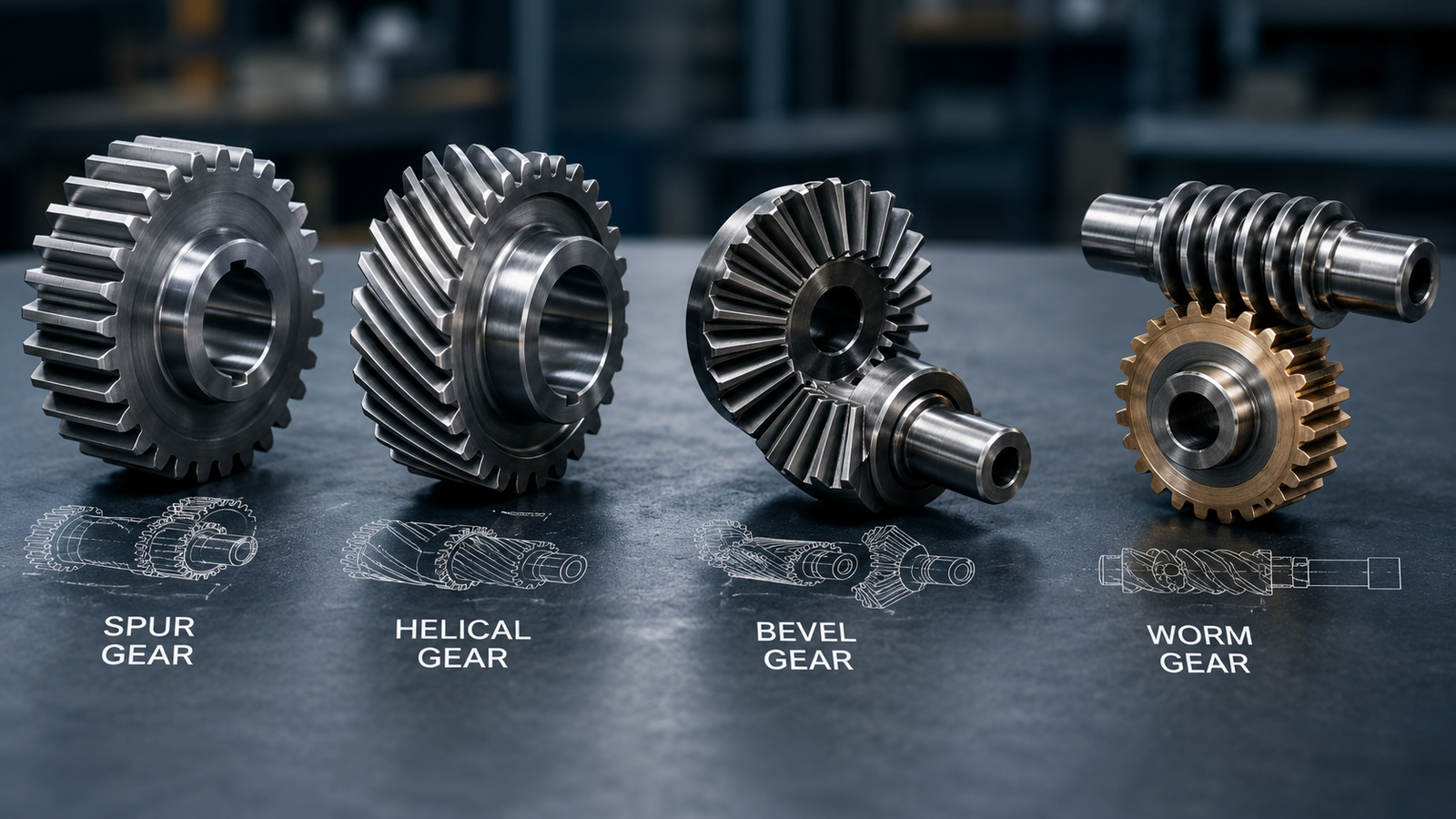
Spur, Helical, Bevel and Worm Gears: Understanding the Right Gear for Every Application
Gears are among the most important mechanical components used in modern machinery. From automotive transmissions and agricultural equipment to construction machinery, hydraulic systems, and industrial gearboxes, gears enable controlled power transmission between rotating components.
However, not every gear performs the same function.
Different applications require different gear geometries depending on shaft arrangement, operating speed, torque, noise requirements, efficiency, and available installation space. Selecting the wrong gear type can result in excessive noise, inefficient power transmission, accelerated wear, and reduced equipment life.
Spur gears, helical gears, bevel gears, and worm gears are among the most commonly used gear types in industrial applications. Each has distinct characteristics and advantages.
In this article, we explore how these four gear types work, where they are commonly used, and the factors engineers consider when selecting the right gear for an application.
Why Gear Selection Matters
A gear system does more than transfer rotational motion.
Depending on the design, gears can:
- Increase or Reduce Speed
- Increase Output Torque
- Change the Direction of Rotation
- Transfer Power Between Shafts
- Control Motion
- Support Precise Mechanical Movement
The performance of a gear system depends on several engineering factors, including:
- Gear Type
- Tooth Geometry
- Material Selection
- Heat Treatment
- Manufacturing Accuracy
- Surface Finish
- Lubrication
- Alignment
- Operating Load
Selecting the correct gear design is therefore an important part of developing reliable mechanical systems.
Spur Gears: Simple and Efficient Power Transmission
Spur gears are one of the simplest and most widely used gear types.
Their teeth are straight and parallel to the axis of rotation. Spur gears are generally used to transmit power between parallel shafts.
Their relatively simple geometry makes them efficient and suitable for a wide range of industrial applications.
Key Advantages of Spur Gears
Spur gears provide several benefits:
- Simple Design
- High Transmission Efficiency
- Easy Manufacturing
- Reliable Power Transfer
- Wide Range of Sizes
- Cost-Effective Production
Because the teeth engage directly, spur gears can transmit power efficiently.
However, at higher operating speeds, direct tooth engagement can generate more noise and vibration compared with helical gears.
Common Spur Gear Applications
Spur gears are commonly used in:
- Agricultural Machinery
- Industrial Gearboxes
- Material Handling Equipment
- Machine Tools
- Pumps
- Conveyors
- General Engineering Equipment
They are often selected where simplicity, efficiency, and dependable operation are more important than extremely quiet performance.
Helical Gears: Smooth and Quiet Operation
Helical gears have teeth cut at an angle to the axis of rotation.
Unlike spur gears, where tooth engagement occurs more directly, helical gear teeth engage gradually. Multiple teeth can share the load during operation.
This creates smoother power transmission.
Key Advantages of Helical Gears
Helical gears can provide:
- Smooth Tooth Engagement
- Reduced Noise
- Lower Vibration
- Higher Load-Carrying Capacity
- Reliable High-Speed Operation
- Improved Load Distribution
These characteristics make helical gears suitable for applications where smooth and quiet operation is important.
Common Helical Gear Applications
Helical gears are widely used in:
- Automotive Transmissions
- Industrial Gearboxes
- Construction Equipment
- Agricultural Machinery
- Compressors
- High-Speed Machinery
- Power Transmission Systems
One important design consideration is axial thrust.
Because of the angled tooth geometry, helical gears generate axial forces that must be managed through appropriate shaft and bearing design.
Bevel Gears: Transmitting Power Between Intersecting Shafts
Bevel gears are designed to transmit power between shafts that intersect, commonly at a 90-degree angle.
Their conical geometry allows rotational motion to change direction within a compact mechanical arrangement.
Different bevel gear designs are available depending on application requirements, including straight bevel and spiral bevel configurations.
Key Advantages of Bevel Gears
Bevel gears provide:
- Directional Power Transmission
- Compact Mechanical Arrangement
- High Torque Capability
- Flexible Shaft Orientation
- Reliable Mechanical Performance
Common Bevel Gear Applications
Bevel gears are frequently used in:
- Automotive Differential Systems
- Agricultural Machinery
- Construction Equipment
- Industrial Drive Systems
- Marine Equipment
- Machine Tools
Accurate manufacturing and alignment are particularly important for bevel gears.
Incorrect tooth contact or alignment can lead to uneven load distribution, noise, and premature wear.
Worm Gears: High Reduction Ratios in Compact Systems
A worm gear system typically consists of a screw-shaped worm and a mating worm wheel.
This arrangement allows significant speed reduction within a relatively compact system.
Worm gears are commonly used where low output speed and increased torque are required.
Key Advantages of Worm Gears
Depending on the design and application, worm gear systems can provide:
- High Reduction Ratios
- Compact Configuration
- Smooth Operation
- Controlled Motion
- High Output Torque
- Right-Angle Power Transmission
Common Worm Gear Applications
Worm gear systems are used in:
- Lifting Equipment
- Conveyors
- Material Handling Systems
- Industrial Machinery
- Positioning Equipment
- Valve Actuation Systems
A key consideration with worm gears is efficiency.
The sliding contact between the worm and wheel can generate more friction and heat than some other gear arrangements. Material selection, surface finish, and lubrication therefore play important roles in performance and service life.
Spur vs Helical vs Bevel vs Worm Gears
Each gear type is designed for different operating requirements.
Spur Gears
Best suited for:
- Parallel shafts
- High efficiency
- Moderate operating speeds
- Simple industrial power transmission
Primary advantage:
Simple and efficient power transfer.
Helical Gears
Best suited for:
- Parallel or crossed shaft arrangements
- Higher loads
- High-speed operation
- Applications requiring lower noise
Primary advantage:
Smooth engagement and improved load distribution.
Bevel Gears
Best suited for:
- Intersecting shafts
- Directional power transfer
- Differential and angular drive systems
Primary advantage:
Efficient power transfer between shafts operating at an angle.
Worm Gears
Best suited for:
- High reduction ratios
- Compact drive arrangements
- Controlled low-speed movement
- High torque applications
Primary advantage:
Large speed reduction within a compact mechanical system.
There is no universally superior gear type.
The correct selection depends entirely on the application’s mechanical and operating requirements.
Important Factors in Gear Selection
Engineers consider multiple factors before selecting a gear type.
Shaft Arrangement
The relative position of the input and output shafts is one of the first considerations.
Parallel shafts may use spur or helical gears, while intersecting shaft systems may require bevel gears.
Worm gears are commonly used for right-angle arrangements where significant speed reduction is required.
Torque Requirements
Higher torque applications require suitable tooth geometry, material strength, heat treatment, and gear dimensions.
Operating Speed
At higher speeds, noise, vibration, lubrication, and heat generation become increasingly important.
Noise and Vibration
Applications such as automotive transmissions may require smoother gear engagement and lower noise.
Helical gears are often suitable for these conditions.
Efficiency
Efficiency requirements can influence gear selection.
Spur and helical gear systems can provide high mechanical efficiency, while worm gear efficiency depends heavily on design, ratio, materials, lubrication, and operating conditions.
Available Space
Compact equipment may require gear systems capable of achieving the required transmission ratio within limited installation space.
Material Selection for Industrial Gears
Gear performance depends heavily on material selection.
The correct material depends on:
- Operating Load
- Required Hardness
- Fatigue Strength
- Wear Resistance
- Impact Requirements
- Heat Treatment Process
- Expected Service Life
Common materials may include:
- Carbon Steel
- Alloy Steel
- Carburizing Steel Grades
- Stainless Steel
- Application-Specific Engineering Materials
For demanding applications, forged gear blanks may be used to provide favorable material flow and mechanical properties before machining and gear cutting operations.
The Gear Manufacturing Process
Precision gear manufacturing involves several coordinated production stages.
Depending on the gear type and application, the process may include:
- Material Selection
- Forging or Gear Blank Preparation
- CNC Turning
- Gear Cutting
- Heat Treatment
- Gear Finishing
- Grinding Where Required
- Gear Inspection
- Final Quality Validation
Each stage affects the performance of the final gear.
A high-quality gear requires control over material properties, blank geometry, tooth accuracy, heat treatment, surface finish, and final inspection.
Gear Hobbing and Gear Shaping
Gear hobbing is widely used for manufacturing external gears.
A rotating cutting tool progressively generates the required tooth profile as the gear blank rotates in a controlled relationship with the tool.
Gear shaping uses a reciprocating cutting tool and can be suitable for applications such as internal gears and geometries where hobbing may not be practical.
The correct manufacturing method depends on:
- Gear Geometry
- Production Volume
- Accuracy Requirements
- Component Design
- Application Requirements
Why Gear Grinding Matters
Gear grinding is a precision finishing process used when high levels of tooth accuracy and surface quality are required.
It can help improve:
- Tooth Profile Accuracy
- Surface Finish
- Noise Performance
- Gear Engagement
- Transmission Efficiency
- Operating Reliability
Gear grinding is particularly valuable in demanding applications where gears operate at high speeds, under significant loads, or where noise reduction is important.
The Importance of Gear Testing
Manufacturing a gear is only part of the process.
The finished gear must also be inspected to confirm that it meets the required specifications.
Gear inspection may evaluate:
- Tooth Profile
- Lead Accuracy
- Pitch Variation
- Runout
- Tooth Thickness
- Dimensional Accuracy
- Surface Condition
Specialized gear testing equipment helps manufacturers verify critical tooth geometry.
Accurate inspection is essential because small variations in gear geometry can influence noise, vibration, load distribution, efficiency, and service life.
Gear Applications Across Different Industries
Different industries require different gear solutions.
Automotive
Automotive applications use gears in transmissions, differential systems, reduction gearboxes, and other drivetrain assemblies.
Farm Equipment
Tractors, harvesters, tillage equipment, and other agricultural machines depend on reliable gears for transmission and power delivery.
Construction Equipment
Excavators, loaders, cranes, and other heavy equipment require durable gears capable of operating under changing loads and demanding environmental conditions.
Hydraulic Equipment
Gear-driven systems may support pumps, actuators, drive systems, and other hydraulic applications.
General Engineering
Industrial machinery, conveyors, pumps, and custom mechanical systems use different gear types depending on speed, torque, and shaft configuration requirements.
Future Trends in Gear Manufacturing
Gear technology continues to evolve alongside modern machinery.
Future developments include:
- Higher Accuracy Gear Manufacturing
- Advanced Gear Grinding
- Improved Surface Engineering
- Lightweight Gear Designs
- Smart Manufacturing Systems
- Automated Gear Inspection
- Digital Production Traceability
- Advanced Materials
- Low-Noise Gear Systems
Electric mobility, automation, advanced agricultural machinery, and energy-efficient industrial systems are creating new performance requirements for gear manufacturers.
Future gears will need to deliver greater efficiency, accuracy, durability, and consistency.
Conclusion
Spur, helical, bevel, and worm gears each serve different mechanical purposes.
Spur gears provide simple and efficient power transmission. Helical gears offer smoother operation and improved load distribution. Bevel gears transfer power between intersecting shafts, while worm gears provide significant speed reduction in compact systems.
Selecting the right gear requires careful evaluation of shaft arrangement, operating speed, torque, efficiency, noise, available space, materials, and application conditions.
However, correct gear selection is only the beginning.
Reliable gear performance also depends on material quality, precision machining, controlled heat treatment, accurate tooth generation, finishing, grinding where required, and systematic quality inspection.
As industrial equipment continues to become more advanced, efficient, and performance-driven, precision gear manufacturing will remain essential across automotive, agriculture, construction equipment, hydraulic systems, and general engineering applications.
Explore Flexico International’s Gear Manufacturing Capabilities
Looking for a manufacturing partner for precision gears and power transmission components?
Flexico International supports industrial customers with capabilities across gear manufacturing, precision machining, forging, gear finishing, and quality inspection.
Our manufacturing solutions support spur gears, helical gears, bevel gears, worm gears, shafts, and other precision-engineered components for automotive, farm equipment, construction equipment, hydraulic systems, and general engineering applications.
Your Blueprint, Our Precision.